Showing posts with label ONCOLOGY. Show all posts

Friday, 20 May 2011

Atlas of Pathology images of Fibrocystic disease changes

A mass characterized by fibrocystic change is a pathological rather than a clinical diagnosis. A fibrocystic mass is diagnosed based on the presence of 2 important features: fibrous connective tissue and cysts

Fibrocystic changes are defined as Cystic changes and apocrine metaplasia involving terminal duct lobular units (TDLU) of breast tissue.

This image shows Extensive fibrocystic changes in serially sectioned formalin fixed breast tissue :
Note that the cysts are of various size are interspersed by dense fibrous tissue. This patient, who was in a high risk category for breast carcinoma, elected to have bilateral mastectomies with prosthetic implants. This degree of "fibrocystic change" becomes impossible to follow on mammograms due to complex shadows from the dense fibrous tissue.

Another gross picture for breast tissue with fibrocystic changes :


Note presence of "Blue dome" wich is a benign cysts filled by serous fluid often have this blue color when viewed from the outside


The next image is for Microscopic picture of Fibrocystic changes, including cystic dilatation, apocrine metaplasia, florid ductal hyperplasia, and fibrosis.


Wednesday, 18 May 2011

Wednesday, 4 May 2011

Atypical "Rodent Ulcer" Basal Cell Carcinoma

These lesions are moist ulcers which may not have the characteristic rolled, translucent border of a nodular Rodent Ulcer or Basal Cell Carcinoma BCC. Often, they are much larger than the pre-auricular lesion seen here, and represent neglected lesions.

The typical basal cell carcinoma appears as a small, pearly, dome-shaped nodule with small visible blood vessels (telangiectasias).

Friday, 1 April 2011

Non-healing ulcer of Basal cell carcinoma

A 60-year-old retired construction worker presents with a non-healing skin lesion on the back of his hand that occasionally bleeds when he gets out of the shower. The most likely diagnosis is
  • A) basal cell carcinoma
  • B) squamous cell carcinoma
  • C) superficial spreading malignant melanoma
  • D) actinic keratosis
  • E) keratoacanthoma

The answer is A. (Basal cell carcinoma)
Basal cell carcinoma is the most common form of skin cancer. The lesions are induced by ultraviolet radiation in susceptible individuals. Risk factors include age older than 40, light complexion, positive family history, and male sex. The lesion in the photo has pearly, raised borders with telangiectasia and a central ulcer that may crust. Sun-exposed areas are most commonly affected. Diagnosis is achieved with shave or excisional biopsy.

Treatment is accomplished with excision, electrodessication and curettage, liquid nitrogen application, Moh's surgery, radiation treatment, and topical 5-fluorouracil cream. Almost 50% of patients with basal cell carcinoma will have another within 5 years.

Tuesday, 18 January 2011

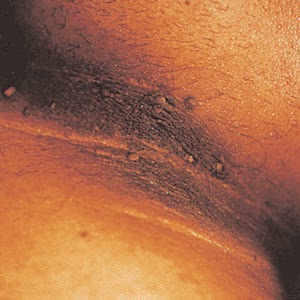
associated diseases with types of Acanthosis nigricans

Which of the following malignancies is associated with the skin condition in the photo?
  • A) Ovarian carcinoma
  • B) Gastric carcinoma
  • C) Malignant melanoma
  • D) Multiple myeloma
  • E) Hodgkin's lymphoma

The answer is B. (Acanthosis nigricans)
Acanthosis nigricans is associated with hyperpigmented areas that typically affect flexural folds (axilla). The two basic types of acanthosis nigricans are benign and malignant.
-The benign form is associated with obesity, diabetes, Stein-Leventhal syndrome, Cushing's disease, Addison's disease, pituitary disorders, and hyperandrogenic syndromes. Drugs, including glucocorticoids, nicotinic acid, diethylstilbestrol, and growth hormone therapy, have also caused acanthosis nigricans. Many cases are idiopathic.
-Malignant acanthosis nigricans is associated with an intestinal cancer such as gastric carcinoma.

Friday, 14 January 2011

Basosquamous Carcinoma in the Temple


This photo shows  large, crusted tumor on the temple that has clinical features of both squamous cell carcinoma (scaly crust), and basal cell carcinoma (translucency in some areas). Histologically, it also has features of both, hence the name basosquamous.

These lesions have a biological aggressiveness intermediate between basal cell and squamous cell carcinomas. They are also called keratotic basal cell carcinoma, squamous cell carcinoma with basaloid differentiation, or "collision tumors."

Monday, 3 January 2011

Histopathology of Osteosarcoma

The staging evaluation of Esophageal Cancer

After establishing a diagnosis of esophageal cancer, adequate staging is required, because staging is the most important step in choosing appropriate therapy. More than 50% of patients have unresectable or metastatic disease at the time of presentation. For the others, survival is closely related to the stage of the disease.
The staging evaluation allows patients to be assigned a clinical stage according to the American Joint Committee on Cancer tumor-node-metastasis (TNM) classification. Informed recommendations about therapy and appropriate information regarding prognosis depends on this clinical staging, an assessment that can, however, only approximate the true disease stage.
 Primary Tumor (T)

* TX: Primary tumor cannot be assessed
* T0: No evidence of primary tumor
* Tis: Carcinoma in situ
* T1: Tumor invades lamina propria (T1a) or submucosa (T1b)
* T2: Tumor invades muscularis propria
* T3: Tumor invades adventitia
* T4: Tumor invades adjacent structures

Regional Lymph Nodes (N)

* NX: Regional lymph nodes cannot be assessed
* N0: No regional lymph node metastasis
* N1: Regional lymph node metastasis
* N1a: One to three nodes involved
* N1b: Four to seven nodes involved
* N1c: More than seven nodes involved

Distant Metastasis (M)

* MX: Distant metastasis cannot be assessed
* M0: No distant metastasis
* M1: Distant metastasis
1. Tumors of the lower thoracic esophagus:
- M1a: Metastases in celiac lymph nodes
- M1b: Other distant metastases
2. Tumors of the midthoracic esophagus:
- M1a: Not applicable
- M1b: Nonregional lymph nodes and/or other distant metastases
3. Tumors of the upper thoracic esophagus:
- M1a: Metastases in cervical nodes
- M1b: Other distant metastases

Wednesday, 22 December 2010

Fibroadenoma

Fibroadenomas, which are generally firm, smooth, and round, can be readily moved under the skin and are often described as feeling similar to marbles. Typically the masses measure from 1 to 3 centimeters in size, but occasionally they may grow much larger, in which case they are termed giant fibroadenomas. Fibroadenomas, which arise from the intralobular stroma, are solid and consist of a combination of glandular and fibrous tissues. The tumors are usually painless and present no symptoms, typically being discovered by young women only due to self-examination. In older women, fibroadenomas are often less palpable and may first be discovered during a routine mammogram.

Fibroadenomas showing circumscribed margins, even distribution of epithelial and stromal components and low stromal cellularity.
-Low power scanning of Fibroadenoma :
# Use low power scanning to determine:
  •  the basic pattern - pericanalicular or intracanalicular
  •  edge of lesion (pushing or infiltrative) - should be pushing
  •  balance between stroma and epithelium - should be even
  •  to pick out areas of stromal hypercellularity


# The stroma can be cellular particularly in younger patient's lesions - but it's usually uniform

# The occasional stromal mitosis is acceptable in a younger patient's lesion but take advice

# Uneven stromal cellularity in a core biopsy may be a pointer to a Phyllodes Tumour

You can suspect Phyllodes Tumour if:
* Patient older than 40 years
* Lesion larger than 4 cm
* History of recent growth

Sunday, 19 December 2010

Kaposi's sarcoma PIC


Kaposi's sarcoma In AIDS patient

Although Kaposi's sarcoma (KS) is a type of cancer it differs from other types of cancer in the way it develops. Unlike most cancers, which start in one place and may then spread around the body, KS can appear in several parts of the body at the same time. The most common site for KS is on the skin but it may also affect internal organs, particularly the lymph nodes, the lungs and parts of the digestive system.

Before the AIDS epidemic, KS usually developed slowly. In AIDS patients, though, the disease moves quickly. Treatment depends on where the lesions are and how bad they are. Treatment for the AIDS virus itself can shrink the lesions. However, treating KS does not improve survival from AIDS itself.

Thursday, 16 December 2010

Nanomaterials Used in Vivo Applications

A handful of nanomaterials are being studied in clinical trials or have already been approved by the FDA for use in humans and many proof-of-concept studies of nanomaterials in cell-culture and small-animal models for medical applications are under way.

Many of these nanomaterials are designed to target tumors in vivo and are intended for use either as drug carriers for therapeutic applications or as contrast agents for diagnostic imaging.
Nanomaterials Used as Drug Carriers or Contrast Agents for In Vivo Cancer Applications.Tumors have poor lymphatic drainage, and their vessels are highly porous. This enables nanomaterials to diffuse and accumulate in the tumor matrix. Nanomaterials that carry chemotherapeutic agents can target and kill tumor cells, whereas nanomaterials that are magnetic or fluorescent are used as imaging agents for detecting tumors.

Nanomaterials infused into the bloodstream can accumulate in tumors owing to the enhanced permeability and retention effect when the vasculature of immature tumors has pores smaller than 200 nm, permitting extravasation of nanoparticles from blood into tumor tissue. The infusion of antineoplastic drugs with nanomaterials as carriers results in an increased payload of drugs to the tumor, as compared with conventional infusion. With nanomaterials, the high ratio of surface area to volume permits high surface loading of therapeutic agents; in the case of organic nanomaterials, their hollow or porous core allows encapsulation of hundreds of drug molecules within a single carrier particle.
When the carrier particle degrades, the drug molecules are released, and the rate of degradation can even be controlled and fine-tuned according to the polymer composition. These nanomaterial delivery vehicles can also be coated with polymers, such as polyethylene glycol, to increase their half-life in the blood circulation, prevent opsonizing proteins from adhering to the nanomaterial surface, and reduce rapid metabolism and clearance. Moreover, the use of nanomaterials for drug delivery may minimize adverse effects by preventing the nonspecific uptake of therapeutic agents into healthy tissues.

Monday, 13 December 2010

Mesothelioma-Exposure To Asbestos

/>

Gynecomastia versus Carcinoma

WE can summarize presentation of male breast disease either as mass, pain or nipple discharge.
Gynecomastia and invasive ductal cancer are the most common lesions in the male breast, but there are other rarer benign and malignant lesions.
Gynecomastia and carcinoma can usually be differentiated, but biopsy is sometimes necessary to separate them.All lesions eccentric to the nipple need biopsy unless they are characteristically benign, i.e.contain fat or typical lymph node.

On this diagram a list of characteristics of gynecomastia versus carcinoma.Notice that there are many similarities.
Both gynecomastia and carcinoma occur mostly at the age of 60 and can be soft, mobile, subareolar and unilateral.
So that does not help.
$$Carcinoma is usually eccentric, while gynecomastia is never eccentric.
$$Gynecomastia has to have extensions into the surroundig fat.
$$Carcinoma sometimes may have spiculations, that can look the same.
Actually we call it extension into the fat, if we think it is gynecomastia and spiculation, if we think it is a carcinoma.

To differentiate between true gynecomastia and pseudogynecomastia

Saturday, 11 December 2010

Diplopia in a Patient with HIV Infection


A 25-year-old man with human immunodeficiency virus (HIV) infection who was receiving highly active antiretroviral therapy presented with a 1-week history of diplopia and headache. The CD4 count was 218 cells per cubic millimeter, and the viral load was 50,000 copies per milliliter.
The neurologic examination revealed an inability to abduct the right eye with horizontal gaze, a finding that was consistent with an isolated right abducens nerve palsy (rightward gaze, Panel A; leftward gaze, Panel B). The examination of other cranial nerves was normal. The remainder of the motor and sensory examination was within normal limits.
The patient reported having had low back pain and constipation for the previous week. There was no history of bowel or bladder incontinence. A gadolinium-enhanced magnetic resonance image of the brain showed a minimally enhancing mass filling and expanding the right cavernous sinus (Panel C, arrow). Lumbar-spine imaging showed a mass with similar radiographic characteristics involving the ventral epidural compartment.
Biopsy of the spinal lesion revealed diffuse large-B-cell lymphoma. A chemotherapeutic regimen of cyclophosphamide, doxorubicin, vincristine, and prednisolone, along with the monoclonal antibody rituximab (R-CHOP), was started. Progressive leg weakness from spinal involvement developed, and the patient had a poor response to corticosteroids and radiation therapy and died 3 months later.

Friday, 10 December 2010

Characteristic Shape of Erythema Gyratum Repens and underlying malignancy


A 83 years old man was evaluated for a 1 year history of a pruritic, progressively worsening migratory rash, with associated weakness and a 5 kilograms weight loss. He had a history of 30 pack year smoking; he had stopped smoking 45 years earlier.

On examination, he had erythematous skin lesions that Characterised by concentric, raised, serpiginous bands, with desquamation (Panel A). The rash affected mainly the trunk and proximal extremities. A clinical diagnosis of erythema gyratum repens was made.

A C.T. scan revealed a pulmonary mass measuring 59 by 43 mm (Panel B). Bronchoscopy with biopsy revealed squamous-cell carcinoma of the lung.

Erythema gyratum repens is a rare syndrome typically associated with an underlying malignant condition. It occurs most frequently in conjunction with lung cancer and next most frequently with esophageal and breast cancers. It may regress with treatment of the cancer.
Treatment with gemcitabine was initiated for this patient, but he died 3 months after diagnosis, after only one infusion; the rash had not resolved.

Tuesday, 7 December 2010

Lymphoma; a common cause of Intussusception above 6 years

An 8 year old is seen in the emergency room secondary to abdominal pain. Further evaluation confirms the presence of intussusception. The most likely precipitating cause is

  • A) colon polyp
  • B) Meckel's diverticulum
  • C) lymphoma
  • D) parasite infection
  • E) foreign body


The answer is ( C ).
Intussusception is the most common cause of intestinal obstruction in the first 2 years of life. It is more common in males than in females. In most cases (85%) the cause is not apparent. Associated conditions that can result in intussusception include polyps, Meckel's diverticulum, Henoch–Schönlein purpura, lymphoma, lipoma, parasites, foreign bodies, and viral enteritis with hypertrophy of Peyer patches.

Intussusception of the small intestine occurs in patients with celiac disease and cystic fibrosis—related to the bulk of stool in the terminal ileum. Henoch–Schönlein purpura may also cause isolated small-bowel intussusception. In children older than 6 years, lymphoma is the most common cause. Intermittent small-bowel intussusception is a rare cause of recurrent abdominal pain.