Showing posts with label UROLOGY. Show all posts

Tuesday, 4 October 2011

Types of Hypospadias


Hypospadias is one of the most frequent male congenital malformations and may be part of the testicular dysgenesis syndrome, It occures 1-2 of 100 boys. Hypospadias is a birth defect found in boys in which the urinary tract opening is not at the tip of the penis. Bending of the penis on erection may be associated and is as chordee.


This picture shows Proximal shaft hypospadias . Note the deficient ventral foreskin, blind urethral pit at the glanular level, and lighter pigmented urethral plate extending to the true meatus at the proximal shaft level.

The location of the urethral meatus was described if visible, and hypospadias was graded as glandular, coronal, penile, penoscrotal, scrotal, or perineal according to the anatomical position


Types of hypospadias classified by the anatomical position of the urethral meatus. 1, Glandular; 2, coronal; 3, penile; 4, penoscrotal; 5, scrotal; 6, perineal.

On examination :A dorsal hood of foreskin and glanular groove are evident, but, upon closer inspection, the prepuce is incomplete ventrally and the urethral meatus is noted in a proximally ectopic position. Rarely, the foreskin may be complete, and the hypospadias is revealed at the time of circumcision. If hypospadias is encountered during neonatal circumcision, after the dorsal slit has been performed, the procedure should be halted, and the patient should be referred for urologic evaluation.
 The most simple classification of Hypospadias is mild, moderate and severe, which can also be called first, second and third degrees of severity. This classification system is based on the location of the external opening for urine and semen (the urethral meatus). In mild or first degree hypospadias, the opening is on the underside of the head of the penis or where the head and the shaft meet. This accounts for about 80% of the cases of hypospadias.

Moderate or second degree hypospadias (15%) occurs when the hole is actually on the shaft of the penis, somewhere between the junction of head and shaft, and the lower part of the shaft. Severe or third degree hypospadias occurs when the hole is located on the lower part of the shaft just in front of the testicles or is located behind the testicles, between them and the anus.

Wednesday, 3 August 2011

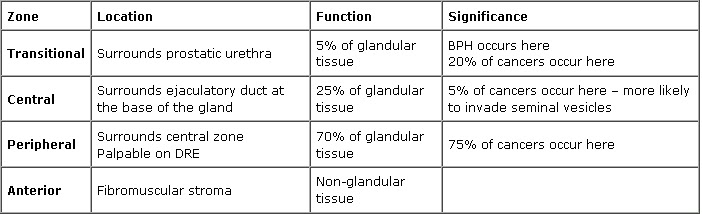
Prostate diseases in relation to Prostate zones

Most cancer lesions occur in the peripheral zone of the gland, fewer occur in the transition zone and almost none arise in the central zone. Most benign prostate hyperplasia (BPH) lesions develop in the transition zone, which might enlarge considerably beyond what is shown.

The inflammation found in the transition zone is associated with BPH nodules and atrophy, and the latter is often present in and around the BPH nodules. Acute inflammation can be prominent in both the peripheral and transition zones, but is quite variable.
The inflammation in the peripheral zone occurs in association with atrophy in most cases.

Although carcinoma might involve the central zone, small carcinoma lesions are virtually never found here in isolation, strongly suggesting that prostatic intraepithelial neoplasia (PIN) lesions do not readily progress to carcinoma in this zone. Both small and large carcinomas in the peripheral zone are often found in association with high-grade PIN, whereas carcinoma in the transition zone tends to be of lower grade and is more often associated with atypical adenomatous hyperplasia or adenosis, and less often associated with high-grade PIN. The various patterns of prostate atrophy, some of which frequently merge directly with PIN and at times with small carcinoma lesions, are also much more prevalent in the peripheral zone, with fewer occurring in the transition zone and very few occurring in the central zone.

Wednesday, 6 July 2011

Surface anatomy of both kidneys on the back

Viewed posteriorly the right kidney has its upper edge opposite the 11th dorsal spine and the lower edge of the 11th rib. Its lower edge is opposite the upper edges of L3 spine and vertebral body and about 4 cm. (1 1/2 in.) above the highest point of the crest of the ileum, which is opposite the fourth spine.The left kidney is usually 1.25 cm. (1/2 in.) higher, but being a little longer than the right, its lower limit may not be quite that much higher. The kidney is slightly lower in women and children than in men. The inner border reaches 10 cm. (4 in. ) and the hilum 4 to 5 cm. (1 1/2 to 2 in.)
Notice that the left kidney is higher (highest border T11 lowest border L2) whereas the right kidney is lower (highest border T12 lowest border L3). The right kidney is less enclosed by the rib cage, because of the presence of right lobe of liver above it, therefore pushing it down. So, the right kidney is palpable during inspiration (moves down by 1 inch).

The renal angle as seen in the image, is located between the

-lower border of the 12th rib
-& lateral border of the erector spinae muscle
Left kidney related to 11th & 12th rib. Right kidney related to only 12th rib.

 Also to indicate the position of the kidney from the back, the parallellogram of Morris is used; two vertical lines are drawn, the first 2.5 cm., the second 9.5 cm. from the middle line; the parallelogram is completed by two horizontal lines drawn respectively at the levels of the tips of the spinous process of the eleventh thoracic and the lower border of the spinous process of the third lumbar vertebra. The hilum is 5 cm. from the middle line at the level of the spinous process of the first lumbar vertebra.
  Back of lumbar region, showing surface markings for kidneys, ureters, and spleen. The lower portions of the lung and pleura are shown on the right side.

Thursday, 7 April 2011

Male Urological Examination

Physical exam by a urologist including kidney, testicular and prostate exam.

Tuesday, 22 March 2011

Botox injections into the bladder

A short video demonstration injections of diluted Botulinum toxin "Botox"into the bladder.

The operation takes approximately 10 minutes and is done as a day-case procedure. It is usually well tolerated under local anaesthesia, but for some women a general anaesthetic may be the preferred option. A very fine needle is inserted into the bladder through a cystoscope , and the diluted Botulinum toxin is then injected into 15-20 sites in the bladder wall.

This treatment is suitable for women with severe urgency, frequency, and urge-incontinence that is unresponsive to other treatment, such as bladder retraining and medications.

Thursday, 30 December 2010

Case of gross hematuria following a game of soccer

A 37 year old male complains of gross hematuria following a game of soccer with his friends at work. He could not recall any particularly severe trauma. On examination both kidneys were enlarged and easy palpable. His blood pressure was raised. A likely diagnosis is :

a) polycystic disease of the kidneys
b) Berger's nephritis
c) systemic lupus erythematosus
d) renal vein thrombosis
e) Goodpasture's syndrome

The correct answer is...................... A

Explanation
In polycystic disease of the kidneys the symptoms or signs first occur between the third and fourth decades of life. These include microscopic and gross hematuria, flank pain and hypertension. The polycystic condition is not confined to the kidneys. Hepatic cysts, usually identified incidentally by sonography, help in making the diagnosis of DPK. These cysts are more likely to be found in adults than in children. Approximately 10% to 40% of patients have berry aneurysms, and approximately 9% of these patients die because of subarachnoid hemorrhages

Wednesday, 29 December 2010

Benign Prostatic Hyperplasia

Many men with benign prostatic hyperplasia experience urinary problems related to the condition. As the prostate enlarges, the gland places increasing pressure on the urethra, often resulting in difficulty beginning or ending urination, an inability to completely empty the bladder, decreased urine flow, and frequent urination. In the most severe cases, complete blockage of the urethra occurs, which may lead to kidney damage.
From microscopyu.com

Benign Prostatic Hyperplasia at 20x Magnification :
Part of the male reproductive system, the prostate gland produces and stores seminal fluids, releasing them into the urethra when semen emission occurs. The gland is located directly below the bladder and surrounds the upper part of the urethra. During adolescence the gland usually matures and reaches a size comparable to that of a walnut. The dimensions of the gland generally remain unchanged for several decades, but in most older men, the prostate begins to enlarge as the size of its cells increases, a process commonly referred to as benign prostatic hyperplasia (BPH) or hypertrophy. According to recent estimates, more than 50 percent of men between the ages of 50 and 60 experience benign prostatic hyperplasia, and over 90 percent of those 70 to 90 years old have developed the condition. Researchers do not yet completely understand the cause of this physiological change, but it is widely thought that elevated levels of the female sex hormone estradiol and increased manufacture of dihydrotestosterone, a derivative of the male sex hormone testosterone, contribute to the condition.

Benign Prostatic Hyperplasia at 4x Magnification :
Men with only mild symptoms of benign prostatic hyperplasia may elect not to undergo any treatment or to simply take a wait-and-see attitude, visiting the doctor regularly for monitoring until signs suggest a more active approach is needed. For those who seek treatment, a number of options are available. For example, drugs such as alpha blockers and finasteride may be used alone or in conjunction with one another to relax prostatic smooth muscle and decrease the size of the prostate gland. Individuals that are not responsive to the typical medications, however, may require a more invasive form of treatment, such as balloon dilation of the urethra or any of several different surgical techniques, including transurethral incision of the prostate (TUIP), transurethral resection of the prostate (TURP), or open prostatectomy. The various treatments for benign prostatic hyperplasia are associated with a number of risks and side effects, which can include serious conditions like incontinence and impotence.

Tuesday, 21 December 2010

Grades of hydronephrosis (on Ultrasound imaging):

A) Mild hydronephrosis:
This images shows mild dilatation of the pelvis as well as the calyces of the right kidney suggesting mild hydronephrosis. The left kidney also appears to be affected similarly. This must be differentiated from mild dilatation of the renal pelvis alone (called splitting of the pelvis), which is physiological and transient; this means that on emptying of the urinary bladder, this appearance should disappear.

B) Moderate hydronephrosis:

The above ultrasound images show cupping of the calyces with moderate dilation (Right kidney) of the pelvis and calyces. Despite the hydronephrosis the renal parenchyma is still preserved.

C) Severe hydronephrosis:

The above sonographic images show marked dilatation of the pelvicalyces with sever thinning of the renal parenchyma. note almost total absence of normal renal tissue (cortex).

Friday, 3 December 2010

Minimally Invasive Surgery Corrects Urinary Incontinence

A DMC patient with urinary stress incontinence regains control with less-invasive surgery at DMC Sinai-Grace, performed by DMC Ob/Gyn specialist Dr. Korial Atty. ~ Detroit Medical Center.