Thursday, 20 October 2011

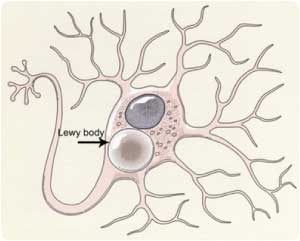
Lewy body dementia when compared to Alzheimer's dementia

Which of the following is more commonly seen in patients with Lewy body dementia when compared to Alzheimer's dementia?
  • A) Hallucinations
  • B) Lip smacking
  • C) Tremor
  • D) Emotional lability
  • E) Repetitive behavior

The answer is A.
Although difficult to know for sure, Lewy body dementia may be the second most common dementia after Alzheimer's disease.
Lewy bodies are hallmark lesions of degenerating neurons in Parkinson's disease "deposits of the protein alpha-synuclein inside nerve cells in the brain"  and occur in dementia with or without features of Parkinson's disease. In Lewy body dementia, Lewy bodies may predominate markedly or be intermixed with classic pathologic changes of Alzheimer's disease. Symptoms, signs, and course of Lewy body dementia resemble those of Alzheimer's disease, except hallucinations (mainly visual) are more common and patients appear to have an exquisite sensitivity to antipsychotic-induced extrapyramidal adverse effects.

Tuesday, 18 October 2011

Essentials of Neuroimaging for Clinical Practice

The use of neuroimaging studies in psychiatry is explodingAand offers tremendous potential for practicing clinicians. Yet if you’re like many psychiatrists, you’re sometimes uncertain about which studies to use in specific situations. Until now, you’ve had to sort through the only information availableAtechnical reviews in the literatureAfor guidance. But no more. Essentials of Neuroimaging for Clinical Practice is an all-in-one resource that explains how to use these powerful techniques to improve outcomes. It demystifies neuroimaging with clear, concise, and practical advice on using today’s most advanced applications in the diagnostic workup of patients. This practical clinical guide will help you achieve a solid understanding of the full range of neuroimaging modalities: -Structural techniques such as computed tomography (CT) and magnetic resonance imaging (MRI) -Functional techniques such as positron emission tomography (PET), single photon emission computed tomography (SPECT), functional magnetic resonance imaging (fMRI), and magnetic resonance spectroscopy (MRS) -Other techniques such as electroencephalography (EEG)Aincluding quantitative EEG and event-related potentialsAand magnetoencephalography. For each modality, you’ll find: -A basic review of the techniqueAtrace the development of each modality, and become familiar with its underlying technology. -Guidance on when to use itAlearn which techniques are best to use in specific clinical situations. -Tips for ordering studiesAdiscover how to write up orders to obtain the most accurate and detailed information from each study, including when to use contrast and how to determine the best acquisition parameters. -A look at its future potential in practice and researchAexplore the current capabilities of each modality and the most promising strategies for improving diagnostic results. Filled with examples of real-life imaging studies, Essentials of Neuroimaging for Clinical Practice is a must-have tool for all practicing psychiatrists and psychologists. In addition, it will serve as an excellent clinical guide for residentsAand an outstanding text for courses in clinical neuroimaging for psychiatrists.

Thursday, 13 October 2011

Tongue`s surface in Prolonged antibiotic use

Which of the following conditions is the skin finding shown in the picture associated with?

  • A) Prolonged antibiotic use
  • B) Sjögren's syndrome
  • C) Addison's disease
  • D) Chronic gastroesophageal reflux
  • E) Malignant melanoma


The answer is A. 
(Black tongue) Black hairy tongue results from hyperplasia of the filiform papillae with deposition of keratin on the surface. The condition causes the tongue to have ..............

Tuesday, 11 October 2011

The Barber's Itch

Barber's itch is a type of Folliculitis "an inflammation of one or more hair follicles".
It is an infectious skin disease which arises on bearded area of the face and upper lip. The condition takes place when the hair follicles get damaged by constant friction with clothing and it may even take place due to blockage and shaving

The disease develops and the first signs of the condition are the appearance of painful pimples that develop at the hair follicles along the beard, these pimples can grow either superficial or may occur in the deeper layers of the skin associated with some common symptoms as rash, itching, and pimples or pustules near a hair follicle in the neck, groin, or genital zone.

The cause that responsible for Barber`s folliculitis may be either a bacterial or a fungal infection :
- Mustache hair is usually affected by the bacteria; staphylococci.
- Bearded hair on the cheeks and the chin is commonly affected by the fungus.

#The condition is aggravated by shaving ,On the other hand the sharing of towels and razors passes on the highly contagious fungal infection